category report
Smoked & Cured Meats
Scott Filbrandt, AAMP president and owner of Michigan-based Bob’s Processing, shares approaches to smoking fish during the 2025 AAMP convention in Kansas City.
Where there’s smoke,
there’s fish
Scott Filbrandt, president of AAMP, shares approaches and considerations for producing and marketing smoked fish during an AAMP 2025 convention workshop.
Chief Editor
By Fred Wilkinson
KANSAS CITY, Mo. – South Haven, Mich.-based Bob’s Processing has found growing business for its smoked fish.
Scott Filbrandt, owner of Bob’s Processing and president of AAMP, shared approaches and considerations for producing and marketing smoked fish products during an educational session as part of the 86th American Association of Meat Processors and Suppliers Exhibition on July 23-26.
Filbrandt said Bob’s Processing smokes around 400 pounds of salmon a week, along with an additional 75 pounds of white fish and 50 pounds of lake trout.
“During the holidays, these numbers double,” he said. Smoked cooked shrimp have also proved popular with Bob’s Processing’s customers. On the wholesale side, Bob’s Processing supplies smoked fish for a retailer and a restaurant as well.
Bob’s Processing vacuum-packs their smoked salmon, which as a shelf life of 21 days, Filbrandt said. Filbrandt said his cost per package is $8 and it retails for $22, and he gets $16 at wholesale..
Filbrandt shared these best practices for smoking fish:
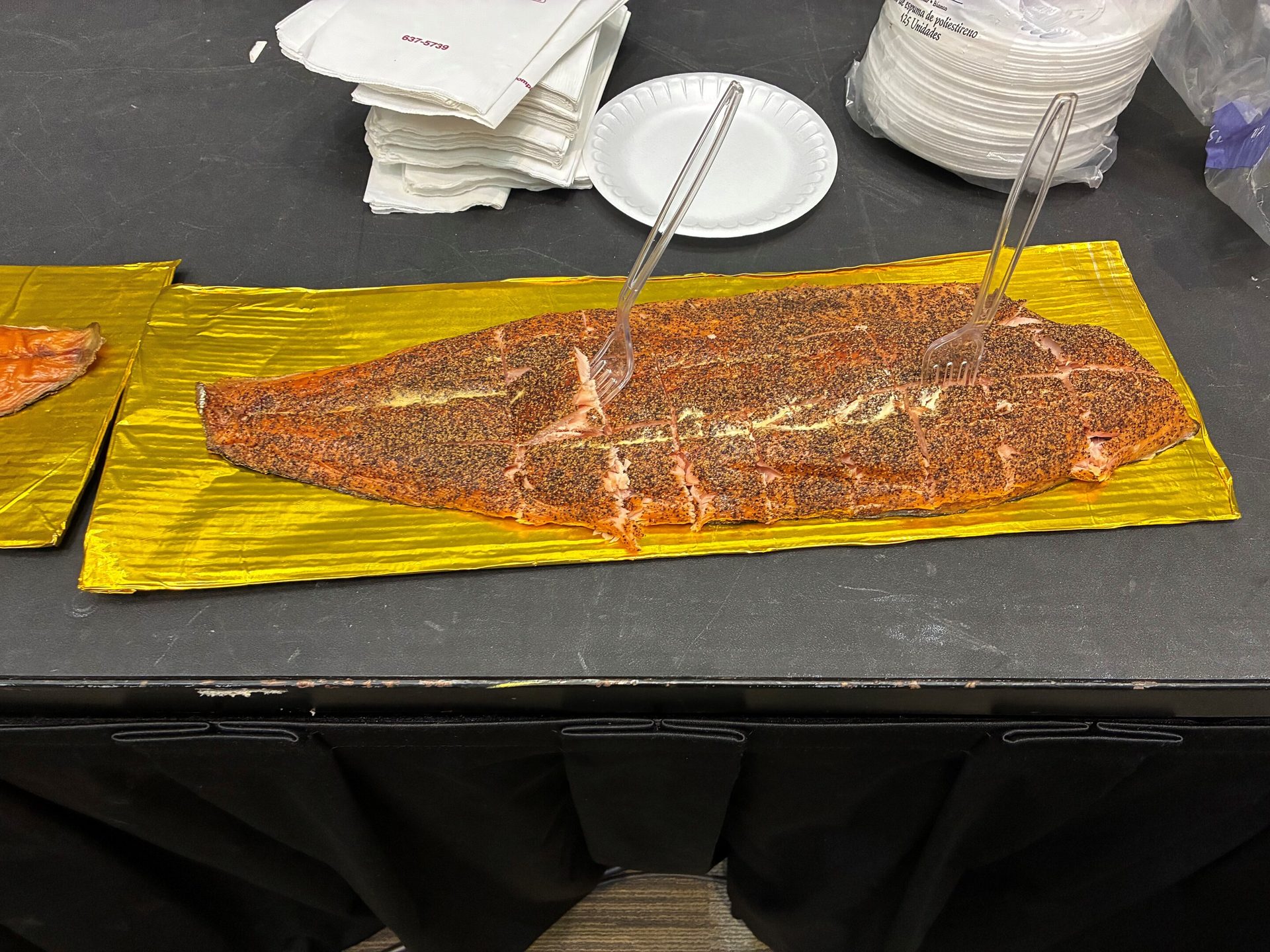
Peppered smoked salmon
Storage of smoked fish — Smoked fish should be kept separate from other products due to the potential for bacteria contamination to fish and odor contamination to other products. Low airflow prevents drying of smoked fish.
Regulations – Smoked fish falls under US Food and Drug Administration jurisdiction (FDA fish product regulations can be viewed here). FDA regulations allow processors to wholesale and retail fish. FDA rules require developing and implementing a HACCP plan. FDA requires water phase salt testing (water phase salt of 3.5%) and water activity below .94 for vacuum-packed fish. Requirements for critical control points include:
- 12-hour soak at 38 degrees F or less (Filbrandt brines half-pound chunks of fresh Chilean salmon in 50 pounds of water with 3.88 pounds of brown sugar cure and 2.5 pounds of salt)
- 145 degrees F internal temperature for a minimum of 30 minutes (chart required)
- cooled to 70 degrees F within two hours, then an additional four hours at 40 degrees F or below for a total six hours (time starts at 135 degrees F)
- stored below 38 degrees F, with cooler temperature not exceeding 40 degrees for more than four hours
- package labelling must include allergen information, lot number and expiration date.
Photos courtesy: Fred Wilkinson