commentary
amsa
Cured color development
with clean-label ingredients
Immediate thermal processing with inclusion of a cure accelerator was determined to be optimal for cured color formation and stability.
The balancing act between meeting consumer demands for clean label and maintaining the same quality afforded by conventional ingredients can be tricky to navigate for meat processors. While the process of meat curing seems simple on the surface, the reality is that it relies on a complex series of chemical reactions, ultimately resulting in the conversion of myoglobin (unstable pigment in fresh meat) to nitrosyl hemochrome (stable pigment in cured meat). In conventional formulations this typically relies on the addition of nitrite (NO2) in the form of sodium nitrite (NaNO2), while in clean label formulations NO2 is incorporated in the form of pre-converted celery or beet powders [high in nitrate (NO3) and fermented to NO2].
An interesting aspect of these reactions is that color has to worsen before it improves. Upon incorporation of NO2, myoglobin will first oxidize to a gray/brown pigment form known as metmyoglobin-NO2. It then must be reduced through either sufficient holding time and/or addition of a reducing agent such as sodium erythorbate (conventional) or acerola cherry powder (clean label) prior to thermal processing to optimize cured color.
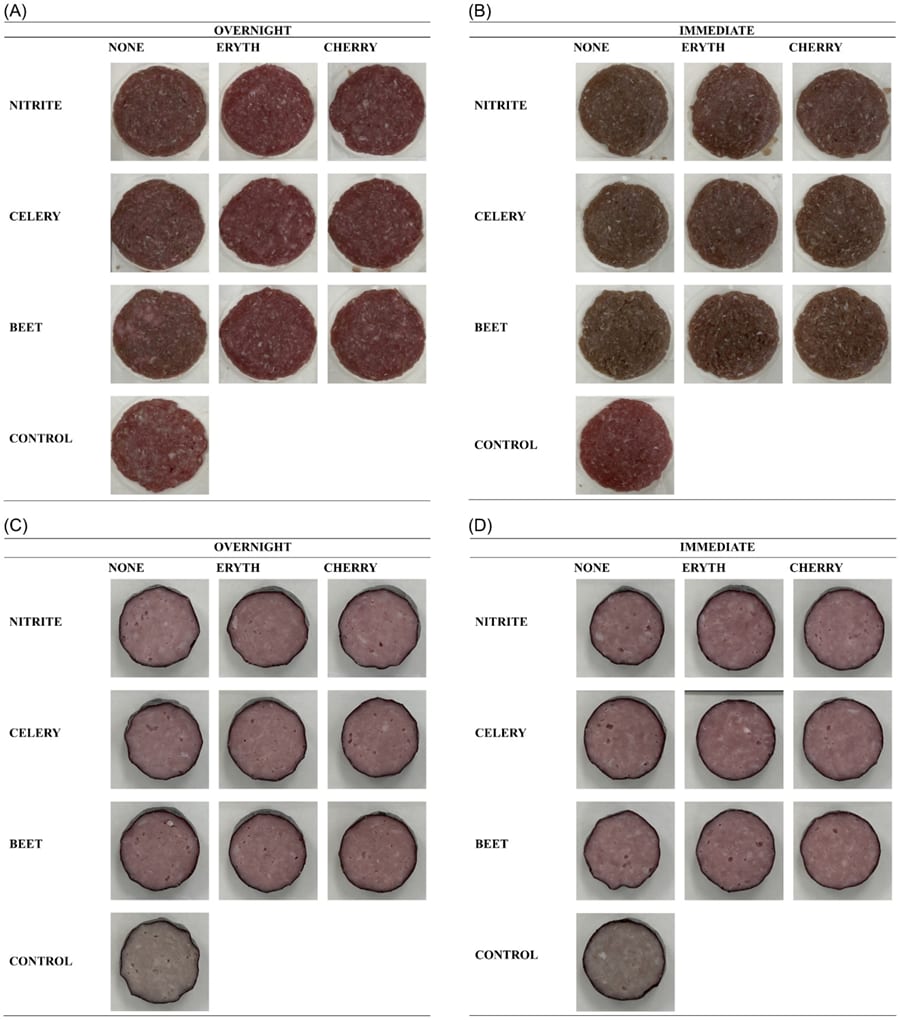
Pork sausage when (A) OVERNIGHT, raw; (B) IMMEDIATE, raw; (C) OVERNIGHT, cooked; and (D) IMMEDIATE, cooked.
Researchers at Northwest Missouri State University and University of Arkansas sought to understand how conventional and clean label curing and reducing agents would fare in pork sausages containing encapsulated citric acid. Formulation with chemical acidulants is often done in the production of semi-dry sausages like summer sausage, and these ingredients also function as cure accelerators. The study aimed to determine the optimal conditions for formulation and processing to achieve desirable, stable cured color in both conventional and clean label products in a product type that differs considerably in pH and composition from what has already been well-studied (e.g., emulsified pork sausage).
In the investigation, sausages were formulated with conventional NaNO2 or clean label celery or beet powders to the same targeted concentration of ingoing NO2. Formulations then included either no cure accelerator, conventional sodium erythorbate, or clean label cherry powder. All formulations included 1.0% encapsulated citric acid and had a resulting pH of ~4.9. Prior to thermal processing, sausages were either held overnight in a cooler or were immediately cooked.
Samples of the raw mixture were collected from each formulation. At the time the cook began, the mixtures that were held overnight with a cure accelerator were considerably more red than the mixtures that had just been prepared. Conversely, in the finished product, sausages that were promptly mixed, stuffed, and cooked had more intense cured color than those that were held. The most intense, stable cured color was achieved through immediate thermal processing in sausages formulated with sodium erythorbate or cherry powder, regardless of the source of NO2.
The team concluded that:
- Clean label sources of NO2 (pre-converted celery and beet) result in similar color to conventional NaNO2 when formulated to the same level of ingoing NO2.
- Although encapsulated citric acid itself functions as a cure accelerator, the inclusion of an additional cure accelerator, either sodium erythorbate in conventional or cherry powder in clean label formulations, can result in an additional benefit to color.
- Holding chemically acidulated sausages overnight allows for oxidized metmyoglobin-NO2 to be reduced. This does not, however, result in more intense cured color in the finished product. The researchers speculated that this was either the result of some loss of moisture (and therefore water-soluble myoglobin) in the cooler and/or premature denaturation of meat proteins through interaction with the citric acid.
Immediate thermal processing of this product type with the inclusion of a cure accelerator was determined to be optimal for cured color formation and stability, regardless of whether the formulation was conventional or clean label.
To read the full study: https://www.iastatedigitalpress.com/mmb/article/id/20106/
Tuell, J. R., Francis, H., Bentz, S., Pitti, A. R., Denzer, M. L. & Setyabrata, D., (2025) “Color Development of Direct Acidified Pork Sausage Containing Alternative Curing and Reducing Agents”, Meat and Muscle Biology 9(1): 20106, 1-18. doi: https://doi.org/10.22175/mmb.20106
Opening photo credit: Getty Images / a-lesa / Getty Images Plus